Remembrances shared by colleagues, friends, and family.
Guestbook
12 recovered entries
A.L. Lauer
IPST Colleagues-
I am very sad to report that Dr. Frank McDonald, Senior Research Scientist with a long history of association with NASA, IPST, and the University of Maryland passed away today, Friday, August 31. Dr. McDonald was giving a presentation at a research seminar at the University of Michigan Ann Arbor yesterday when he collapsed and never regained consciousness. Dr. McDonald's wife and family members were with him at the time of his death. Memorial arrangements have not yet been made and will be announced when available.
Dr. McDonald had a long and distinguished career with the University of Maryland and NASA as Chief Scientist at Goddard Space Flight Center. He was a member of the National Academy of Sciences and a Fellow of the American Physical Society among other honors. He was a colleague and mentor to many and will be missed by all that knew him. Please keep his wife and family in your thoughts and prayers this weekend.
A.L. Lauer, Director Administrative Services Institute for Physical Science and Technology
Eun-Suk Seo
Dear Friends and Colleagues,
It is with great sadness that I report to you the passing of Frank McDonald, who was a great friend and mentor to me and many others. Please post your notes (remembrances or stories about Frank, any words for the family, any thoughts to share either publically or privately) here for his family and friends. Please also Forward this URL to those who may wish to post notes.
Thanks, Eun-Suk
Thomas L. Cline
Frank's career at NASA is beyond compare. His influence at Goddard Space Flight Center, from the late 1950s on, was way outside the framework of his position - initially Branch Head, then Laboratory Chief. He had major roles, directly and indirectly, throughout NASA and in the cosmic ray community. He was primary in the effort to ensure that Goddard would perform original research, as well as enable it, in the space race. Frank, starting with his Fields and Particles Branch, and his Cosmic Ray Section, personally created other globally competitive groups from scratch, including the magnetosphere and solar-interplanetary particles groups, the x-ray astronomy group, two gamma-ray astronomy groups, and the microwave group that created the COBE mission, bringing NASA its only Nobel Prize. Frank's personal style was simply that of unleashing talent rather than managing it. He was the role model and intellectual father to those of us in his Lab, and intellectual godfather to many more. He surely was the most effective leader of those who made Goddard Space Flight Center the world class scientific laboratory it is.
Les meredith
I would like to count Frank as one of my best personal friends over our long overlapping lives.
. Only recetly at his suggestion we had lunch together. As always, he had strong and well justified positions on the many subjects we discussed.
I will sorely miss him! Please give my heartfelt condolances to those he left behind!
Les Meredith
Les Meredith
Jakkals Reinecke
It was my privilege to spend my last sabbatical with Frank in 1998. Frank immediately invited my wife and me into their inner family circle.
We will forever remember the friendship and love we received from Frank and Rene.
Gerald Share
I had the pleasure of speaking to Frank at the University of Maryland a couple days before his passing. He looked trim and happy. As always when I spoke with him I noticed the twinkle in his eyes that seemed to reflect his joy of living and for the research that he was doing. He spoke enthusiastically about the latest Voyager observations. I will miss Frank but my fond memories of him will persist.
Gerry Share
Jean Swank
Back in 1975, when I was a post-doc fellow with the X-ray group, we all gave dry runs of our talks at meetings to an audiance that included Frank and he organized a yearly seminar to show the labs work to the Director of Goddard and others, thus acquainting all of us with other fields. He would walk around the lab and pop in to ask about some issue. In recent years when he was at Univ. of Maryland, I would run into him at the College Park farmer's market and we would immediately launch into reports of what was happening on some mission. He encouraged us to make a mark on the system, if we believed something should be done. He certainly did.
Neil Gehrels
Frank was often at Caltech in the late 1970's collaborating with the Stone/Vogt group on Voyager and other missions. I was doing my thesis on calibrations and data analysis of the Voyager cosmic ray experiment and got to know him well. He worked with Bob Park at UMd to bring Ellen and me to Maryland as postdocs and then the following year to get us permanent positions . He was a big part of our lives while at Goddard and UMd.
Demos Kazanas
Frank's scientific and managerial achievements numerous and important as they are have been discussed by many. My most enduring impressions of Frank are his unassuming demeanor to all (including me, a young postdoc at the lab at the time), an attitude that added to the smooth and efficient running of his lab and his willingness to pay attention, judge and reward in the same unassuming style both achievement and honest effort. I am also grateful for his steady help with a personal problem at my early time at GSFC.
Eugene Parker
Frank's passing marks the end of an era that began in the late thirties with Forbush's discovery of cosmic ray variations. After WWII the variations of cosmic rays and energetic solar particles became a vigorous field of observational discovery, centered in the midwest universities. The energetic particles and their variations showed just how active are conditions at the Sun and in space. I recall the Midwest Cosmic Ray Conferences held at the participating Universities of Iowa, Minnesota, Chicago, Michigan, Washington University, etc. where the latest discoveries were eagerly discussed and theorists were left to speculate. Frank, who was two years older than I, was a major contributor, soon becoming a senior member. It must be appreciated that in the fifties the observations were restricted to ground level and/or with balloon borne instruments carried to high altitudes. Nonetheless, such restricted observational knowledge led to a first picture of conditions in interplanetary space, and, in retrospect, the Midwestern circle of observers was a remarkably active and productive group, with Frank playing a leading role. Frank has had the longest productive career of any of the old gang of the fifties, producing new results up until cut off by the tragedy of his death. And so ends the era of the original Midwest "cosmic rayers", subsequently superceded by the space age with the next generation carrying the torch.
Richard Mushotzky
Dr. McDonald's death came as a great shock. We had been working the day before his death on a letter to Senator Mikulski about the cancelation of the GEMS program. It is like a great tree has fallen, leaving a large hole in the forest. He established the style and tone of space research at Goddard allowing creativity and independence and an academic style, rare at government labs. He managed by 'walking around' and as a young post-doctoral fellow I remember many conversations with him late at night or on the weekends. It was quite amazing to have such access. He will be greatly missed.
Patrick Avery
Frank was a amazing person. He was my moms first cousin. It was always enjoyable when he came to Columbus to visit. You always felt you were in great company.
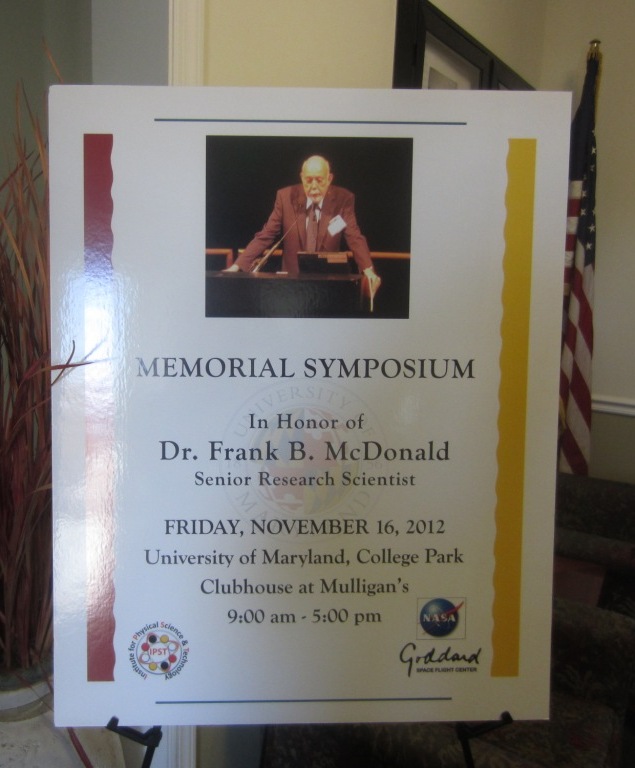
Frank B. McDonald Memorial Symposium
The photographs from both original albums have been recovered and preserved here.